
If 'Just Push Through' Fitness Advice is Failing You, This Might Be Why (And How You Can Build a Sustainable Exercise Routine Instead)
Updated: Sep 3, 2025
Building a Sustainable Exercise Routine with Health Challenges –Part 1

Disclaimer: I am not a doctor or therapist. This blog is based on personal experience and is for informational purposes only. Please consult a qualified medical and/or mental health professional before starting anything new. Full Disclaimer can be found at the bottom of this page. This post contains Amazon affiliate links.
I had a plan.
You know the kind. Where you’ve scheduled out the whole day and you’re going to crush it.
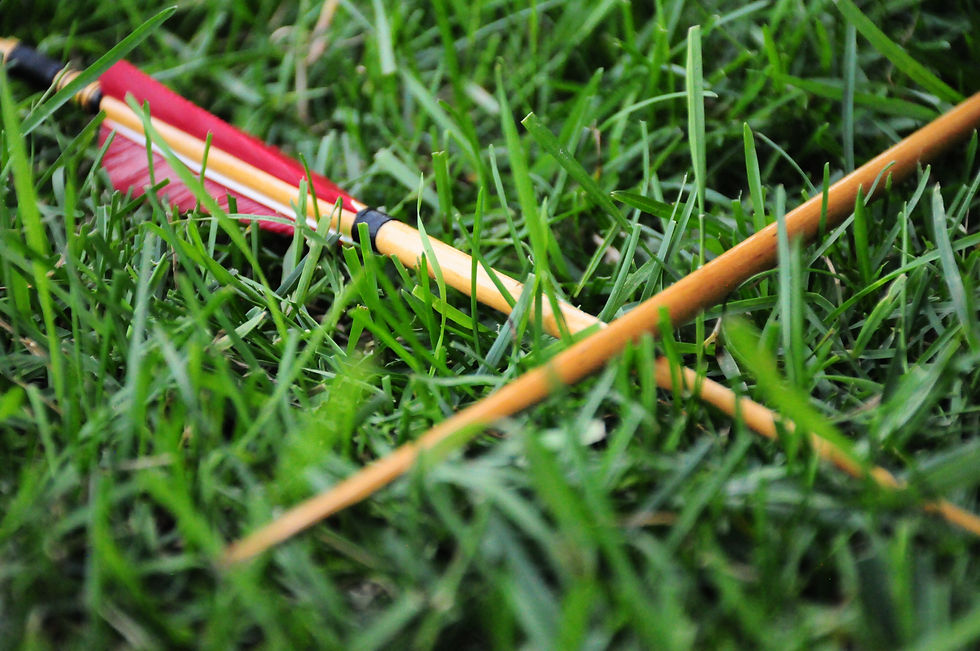
Walk the dog in the morning, write for a few hours, then head to the horses to set up my track, lunge them through it, and work on desensitizing them to arrows being tossed over and off their backs. (Hi, I'm Taryn, and I'm making a comeback by taking up mounted archery in my late 30s while managing a few unpredictable health conditions.)
The thing about chronic illness is your body holds all the wild cards, and it's not afraid to play them.
By the time I got to the horses, a thunderstorm was rolling in the distance, my ear had started screaming, and my ability to balance on two legs like humans are supposed to? Gone.
Ah, the familiar sting of disappointment.
With determination, I walk into the field, spend about 20 minutes brushing the horses and go home. Exhausted and dizzy.
I see you out there, clicking on this article with raw hope under the scarring of constant disappointment and fatigue. You, with health conditions that flip you upside down when the weather changes, or you eat gluten, or you spent too long in the sun. Or you out there struggling with motivation but deep down are a little desperate to try something to get active again.
I get it, I’ve lived it. Except this blog post didn’t exist when I was figuring it out, so I just had to throw myself around and see what happened. Experiment on myself to discover what exactly I needed to keep going after my day that I was so excited about crashed and burned.
Disappointment might be a part of life (without it, we might not know what achievement feels like), but when it hangs around too much... it can be easy to become sour and discouraged.
So how do we prevent that? How can we stay motivated when frustration and shame eats at you? Because I’ve been there, and if I can make it out the other side, I believe you can too.
Your body and mental state might be a wild card, but if you know there are wild cards in the deck, you can be ready for them to show up. So let’s talk about how we can move away from the ‘Just Push Through’ mind frame and into something that will actually motivate you to keep going.
The Problem with "Just Push Through" Mentality

The Over-Simplified Meme Culture
Memes and quotes like the ones above work for some people, but like everything, there is no one-size-fits-all motivational meme for all people and all situations. With a chronic condition, you often can’t ‘just push through’ or ignore your body in favour of ‘showing up every day.’ Because that will lead to crashes and flare-ups. I’ve been there enough times to know for a fact that determination is not enough.
While these concepts are over-simplified, I wouldn't call them toxic – for some people, it really is about pushing through their 'mood' to build healthy habits. It works for them. Just probably not for you (since you're here). And me.
But because it’s the motivational approach that most exercise and gym personalities use (it worked for them), it’s what we see everywhere. And unfortunately, we internalize it. As people who have had health setbacks or major life upheavals, we’re people trying to find and rebuild our former or younger selves, so we often desperately cling to that mentality, only to circle back to the same old disappointment and frustration.
Thus starts the guilt cycle:
planning ambitious routines → failing to stick to them → feeling like you're not dedicated enough
Or: planning ambitious routines → sticking to them until you get sick → feeling lost, frustrated and like a failure.
The All-or-Nothing Trap
The All-or-Nothing Trap is real, and I’ve been guilty of falling into it more times than I care to admit. We must do it. Or not do it. There is no try (ha). There is no flexibility. There is no allowance for ‘partial wins.’
The constant barrage from social media’s fitness corners exaggerates the problem and after a while... it sticks to you. Then you have to decide whether you’re ‘in it’ or not. And when your body, health, or mental state gives up, you’re forced into the ‘not’ category with no flashlight to find your way out. That’s a dark place to be in.
In fact, it actually demotivates you. The All-or-Nothing mentality becomes a weight on your already overburdened system because it turns every setback into total failure. You succeed or you fail. There’s no middle ground, no compromise, no negotiation.
Even worse, it makes your health challenges feel like character flaws instead of realities to work with.
So how are you supposed to pick yourself up and dust yourself off with that hanging around your neck? You can’t. Your motivation dwindles and eventually you give up, forgoing the fun and health that is achievable for you because you can’t live up to that impossible standard.
I know that you know it’s true because I’ve lived it too. But I also know there are other approaches that can work with you. Ones better suited to your reality.
So, how can you build a consistent and sustainable training routine if you can’t rely on your body to consistently show up?

Redefining Consistency
What Consistency Actually Means
What does consistency mean to you? Does consistency mean every day? Every other day? Three times a week? How about once a week?
If you managed to find a medium energy (or better) day one time every week for 6 months, wouldn’t that be consistent?
If you signed up for a 10 week ballroom dancing class, and showed up 9 out of 10 times, wouldn’t that be consistent? What if on one of the 9 days you could only make it half way through. Would you still consider that consistent? What about 2 of those days?
I want you to define where you believe consistency starts and ends, and write it down. Find a journal and lay out exactly what you think consistency is or is not. Because when you get clear on that, you can get clear on exactly what you need to do to feel like you’ve achieved it.
I don't think I've ever really believed that consistency means doing something every day. However, did I want to believe that? Sure. But it’s just the all-or-nothing mentality disguised as something else. I've learned the hard way that consistency doesn't actually mean doing something every day - even for the most healthy person on the planet.
Sustainable Consistency Framework
Now that we've defined what consistency means to you personally, let’s see if we can achieve that in a sustainable way.
In other words, what consistency could be sustained over an extended period of time for your individual body and personality? Where can we find the sweet spot between our ambitions, what we find fun, and what our bodies can handle? That crossroads is where sustainable consistency lives.
Let’s take stock of where you are right now. In that same journal, answer these 3 questions:
What is my external motivation/goal? (Answer this in a simple sentence that doesn’t mention your health or fitness level: “To go hiking more with my friends.” “To start running again.” “To get back into tennis.” “To go canoeing with my dog this summer.”)
What benefits would come from achieving that goal? (This is where you write your internal goal e.g., "Feel stronger.” “Not get out of breath so easily.” “Lose 15lbs.”)
On a scale of 1 to 10, what is the gap between your current reality and your ambition? (1 being a small ditch, 10 being the Grand Canyon.)
Now that you’ve written down numbers like 5,784 on your scale of 1 to 10 (I see you), let’s look at how small a step you could take toward your goal. Let's shrink that gap, one point at a time.
If your goal is to start running again: Can you walk for 10 minutes once a week? How about twice a week? What about 20 minutes? If you do that for 4 weeks, is that sustainably consistent for you? What about 2 months? Doesn't matter which day of the week, or even if it's the same days each week – just 20 minutes of walking, twice a week. That's it.
Avoid the days you wake up with -5 energy. Don’t do it on those days. But maybe think about doing it on the days that you have +4 energy. It may not be a +10 day, but is it enough to walk for 20 minutes?
Remember that ballroom dancing question? Would it still be considered consistent if you went to 9 out of 10 classes but only managed half of a couple of them? Well, on those weeks that hit you hard, would it be sustainable to do two 10-minute walks instead? If you don’t believe it would, write down your reasons.
Then ask: are you encouraging yourself or discouraging yourself?
As a coach in a sport that includes an animal that can fully take over and decide to do something else entirely, I can tell you that being flexible gets you so much further than being rigid.
Both horses and riders can have ‘off’ days. Days they’re distracted or tired. It’s far better to use those days to practice something easier. At the very least, it builds confidence and reminds you that you have something to work with, even if you’re not at your goal yet.
If you’re not familiar with horses, then you can think of your body as your dance partner. Some days, your dance partner steps on your toes. It happens, but does that mean you never dance with them again? No, you just take things slower. Go back to the basics and build from there.
Even elite athletes have 'off' days and go back to work on the basics. You can too.
The 3-Option Solution
Introduction to Planning for Unpredictability
How can we actually prepare for days when things go off the rails? How can we work with unpredictability instead of fighting it, and still feel a sense of achievement (or at least satisfaction) when our perfectly planned training session now seems impossible?
Part of the puzzle is fostering a sense of agency. The more you feel that, the more empowered you’ll be to continue. But how can you take back some agency when your health throws a bucket of ice water over your head whenever you feel like you’re getting somewhere?
Well, you need a system in place to help you. And that’s where The 3-Option Solution comes in.
I’ve mentioned this in a previous blog post, but I’m going to go over it here because it’s something you can start doing tomorrow that will help well into the future.
This is your plan for when your plan didn’t work.
The System Breakdown
Plan A: What you'd do on a great day
You run for 5 minutes, or
You head out to the tennis court with a friend, or
I do a full riding session with my horse
Plan B: What you can do on an okay day
You walk for 15 minutes, or
You take your racket out and practice a couple of techniques against a wall by yourself, or
I work my horse from the ground for 30 minutes
Plan C: What you can do on a tough day
You do some stretches at home, or
You practice some simple hand-eye coordination exercises like tossing a ball back and forth between hands while sitting on the couch, or
I stretch and do mobility exercises while sitting on the couch or floor
It only has to be as detailed as you need it to be. And if your exercise or training sessions are pretty similar, you can reuse the same 3 options over and over.
When you have this in place, your brain still registers your Plan B’s success as achievement, creating more motivation for the future. This will also help remove decision fatigue (when you’re already not your best) and any guilt for not doing what you originally planned.
Making the Switch Without Drama
Some days you still won't know your capacity until you try. You’ll think you’re doing well, then run out of steam faster than you thought. That’s okay.
It's okay to start Plan A and switch to Plan C halfway through.
This is what working with your reality looks like in practice. This is what will help you achieve your goals at the pace your body needs. This is where building a sustainable exercise routine starts. It allows you to be flexible while still moving forward, and creates gentle accountability that doesn’t shame.
As a coach, I've had to learn to pivot on the spot when something isn’t working. Pivoting while still maintaining some momentum helps keep you from spiraling into the feeling of frustration, because you still accomplish one of your 3 plans. Be that coach to yourself. Encourage, don’t discourage.
Plus, it helps lift you up when you start to fall into a disappointment spiral because you’ve been able to do Plan A for a week now but the next week is all Plan Bs. But with this, you were still following your plan. You still got something done.
Working With Your Reality
The Foundation Shift
Sustainable doesn't necessarily mean slow. It actually means building something that can weather your worst flares and health setbacks and still be there when you resurface.
Traditional training mentality thinks in weeks and months. Sustainable training starts with where you’re at and helps you get where you want to go by being accountable and flexible – using what you have right now and finding motivation even on the Plan C days.
This isn't about building a spectacular and unrelenting regime that burns out in three months. It's about building something sustainable that's still serving you three years from now. Your future self will thank you for choosing this path.
Give yourself permission to build something that might take a little longer, but will give back so much more than you expect. Whether you're dealing with chronic illness, recovering from injury, managing mental health challenges, or just rebuilding after life knocked you sideways, this approach works because it honours where you actually are, rather than where you think you should be.
Remember: your health limitations aren't character flaws. They are realities that can be worked with. Sometimes your dance partner steps on your toes, but isn't that better than the crash and burn cycle you were stuck in?
Starting Where You Are
So you’re tired, your health has taken it out of you. It does that to everyone. At some point everyone gets sick, everyone gets injured. It’s normal. It might be a little more exaggerated in your case, but that’s your normal.
For now, start with the 3-Option Solution and see how you do with it. See how this little shift changes the way you view your fitness journey. I have much more to say about reading your body's signals and managing different types of energy, but that's coming up in the next post.
So What's Next?
What's your first 3-option plan going to be? Let me know in the comments below!
Every day that you check in with your body and make an informed decision is a victory. It's agency. It's motivation.
Coming up next: Energy management strategies, reading your body's warning signs, and how to bank different kinds of energy on different days.
Ready to break the crash-and-burn cycle? Get my Free 5-Day Movement Reboot email series and learn to work with your unpredictable energy instead of against it. No equipment needed, no perfect days required—just practical strategies that actually work with your reality. Get started for free!
Want to find out what hidden strengths your health setbacks have taught you?

"The strongest people are not those who show strength in front of us, but those who win battles we know nothing about." —Unknown
If you’d like to support this blog or my journey, buy me an arrow! (The land spirits take them as sacrifices.)


Comments